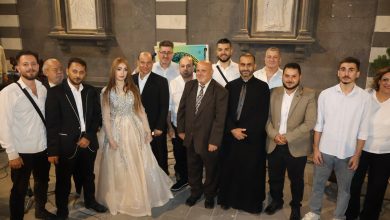
ؤتمراً صحفياً عقده المطران مار يوليان يعقوب مراد والمونسنيور باول بتاسنك من مؤسسة يوحنا بولس الثاني الفاتيكانية

(OSV News) — For Syrian Archbishop Jacques Mourad of Homs, who was held captive by the Islamic State group for five months in 2015, receiving an award named after St. John Paul II was a hopeful reminder of the late pontiff’s efforts to advance peace and dialogue in uncertain times.
In a phone interview with OSV News Oct. 17, Archbishop Mourad said St. John Paul’s experience living through World War II meant he knew “well what war means, what evil, what suffering it causes.”
“For all of us who live in a time of war that has not ended for 14 years now, the teaching of St. Pope John Paul II is a very important reference point, above all,” he said.
Award to be presented Oct. 18 at Vatican
The John Paul II Award will be presented to Archbishop Mourad during an Oct. 18 ceremony at the Vatican, the foundation said.
According to Msgr. Paweł Ptasznik, head of the administrative council of the John Paul II Vatican Foundation, “the award was created to promote those people and communities who carry out their activity inspired by the teaching and work” of the Polish pontiff.
Archbishop Mourad was chosen by the foundation’s jury, “almost unanimously, even though we had about 20 candidates,” Msgr. Ptasznik told OSV News Oct. 17
“The situation in the Middle East in general, and the sufferings that the people have had to endure, made us think of Archbishop Mourad, who, on the one hand, is very committed to the issue of interreligious dialogue and, on the other hand, does so inspired by the teaching and the work of St. John Paul II,” Msgr. Ptasznik said.
‘He continues in this work’
“We chose Archbishop Mourad, who suffered for the dialogue between Christianity and Islam and did not stop,” he added. “He continues in this work, which is not easy.”
Before serving as Archbishop of Homs, Archbishop Mourad was a member of Deir Mar Musa, a monastic community restored in the 90s by Jesuit Father Paolo Dall’Oglio.
Father Dall’Oglio was kidnapped in 2013 by Islamic State militants in Raqqa and presumably killed.
Calling the late Italian Jesuit a “champion of dialogue in Syria,” Archbishop Mourad told OSV News that the monastic community’s charism “was always to work through hospitality, to build the path of dialogue of peace and coexistence.”
Dedicated his life ‘to this charism’
“I dedicated practically my entire monastic life to this charism, this path,” he said, noting the strong ties between Christians and Muslims, when he served as rector of the Mar Elian Church in Qaryatain, Syria.
Many Muslims who lived near the church, he recalled, would come to the church to pray before the relics of St. Elian, a third-century Syrian martyr, “because for them this saint is also a saint, a wali (holy person). So, they come to pray and to ask for a blessing.”
Those encounters, he continued, were an opportunity to meet and build friendships, especially during the war, as he tried to help the injured and those fleeing the conflict.
Recalling his three-month captivity, Archbishop Mourad said during that time, he “truly understood that the path of dialogue sustained by prayer is the only road, the only way … to achieve this peace.”
A man of faith is ‘a man of peace’
“If I say I am a man of faith, it means I am a man of peace because we cannot put things against each other,” he told OSV News.
“This point is very important because today, with the way of the fanatical Muslims who practice violence in the name of God, they do not understand that this is not the God they worship; this is another God that they have constructed, that they have founded,” he explained.
“Because God — ‘the Merciful, the Clement,’ as we say in Arabic — is not a God who kills, who tortures. In fact, during my kidnapping experience, I confronted this because they truly changed their position only because I tried in a simple way to understand their violence, not to judge them. This is very important: not to judge one another.”
Initial hopes of peace after Assad overthrow
After former Syrian ruler Bashar Assad was overthrown, ending his family’s 53-year rule, there were initial hopes of peace following Syria’s interim president, Ahmed al-Sharaa, meeting with Catholic, Orthodox, and Anglican leaders of the country in December 2024.
However, according to Archbishop Mourad, things have not changed for the better in Syria, not just for Christians, but for the entire population.
“It’s the same thing, nothing has changed; concretely, it is like this,” the Syrian archbishop told OSV News. “We must not listen to the official speeches that the current government makes because it is not the reality that we live every day.”
“The violence, the corruption, the evil continues,” he lamented.
Junno Arocho Esteves writes for OSV News from Malmö, Sweden.