Monastery of Mar Elian
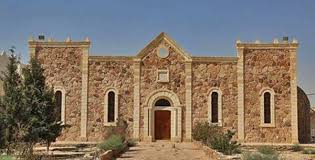
Monastery of Mar Elian :
Al-Qaryatayn is an ancient city that dates back to about the third millennium before Christ. It was called by this name because it means two cities. The first and its Aramaic name is (Hasar Ainan), which means the complex of springs. As for its older name, as some historians say, it is Sumerian (Nazala). In the time of the Romans, it was called (Qaraadi) and the second is called Aramaic (Ainata) means spring of water.
The city of Al-Qaryatayn is located in the heart of the Syrian desert, and it constitutes an important station on the way for caravans of merchants and pilgrims passing on this road between Mesopotamia and the Mediterranean.
The abundance of natural fresh water springs, which numbered more than twenty-two, was the basic element for the emergence of civilization and human settlement there five thousand years ago.
What remains of these springs, which dried up little by little in the second half of the twentieth century, is a natural oasis of water springs that form a small lake surrounded by a forest of various trees, which is what we call today (Wadi Al-Ain), and from it the water flows through canals organized by farmers to irrigate their lands, which It has been planted since ancient times and is famous for its vineyards and fenced with pomegranates and figs.
The people of the region were pagans, worshipers of the sun god (Bul-Ahadd). Then they embraced Christianity at its dawn at the hands of the Apostle Thomas, who passed through it on his way to India. Evidence of this is the existence of the oldest church named after him, which was mentioned in some manuscript writings dating back to the ninth century AD.
In the fifth century AD, Al-Qaryatayn was a bishopric and was affiliated with the Patriarchate of Antioch, and its bishop attended the Chalcedonian Council in the year 451 AD.
Mar Elian Monastery is witness – as well as the ruins – of Christian churches or sites such as Hawarin, in which we find seven churches and a monastery dating back to around the fifth-sixth centuries AD, highlighting the importance of the Christian presence since the first centuries of Christianity in the region.
This presence continues to this day in the cities of Al-Qaryatayn, Sadad, Al-Hafar and Al-Fahila
Biography of Saint Elian and history of the monastery:
The most important sources that introduce us to the life of Mar Elian Sheikh are hymns by Saint Ephrem the Syrian, one of Saint Elian’s students, as he wrote twenty-four Mimers in praise of his teacher. The biography of Saint Elian of Rahawi was written by the historian Theodore of Cyrus in his book, The History of the Beloved of God, and dates back to the fifth century AD.
Saint Elian was born in the current Edessa-Urfa region, which is currently a Turkish city, at the beginning of the fourth century AD. He was famous for his asceticism, fasting, and isolation in one of the caves in the Edessa Mountains. He gathered around him more than a hundred men to live a life of asceticism and worship like him.
Among his students was Saint Ephrem the Syrian, teacher of the Universal Church.
He was very famous for performing miracles, including healing the sick and raising the dead in the name of the Lord Jesus of Nazareth. Every year, at the beginning of Lent (the beginning of spring), he went with some of his students on a pilgrimage trip, crossing the desert on foot for forty days and forty nights in order to pray with Christ on Palm Sunday and enter with him into Holy Jerusalem. They celebrate with the church there the Holy Week of Redemption and Resurrection and then return to their rituals.
Among his students was Saint Ephrem the Syrian, teacher of the Universal Church.
He was very famous for performing miracles, including healing the sick and raising the dead in the name of the Lord Jesus of Nazareth. Every year, at the beginning of Lent (the beginning of spring), he went with some of his students on a pilgrimage trip, crossing the desert on foot for forty days and forty nights in order to pray with Christ on Palm Sunday and enter with him into Holy Jerusalem. They celebrate with the church there the Holy Week of Redemption and Resurrection and then return to their rituals.
He fell asleep in the Lord in the year +364 AD and was buried in Al-Qaryatayn, where his monks built a monastery for them with mud (brick) and stones in which they lived, and it was the beginning of an ascetic monastic life in the wilderness.
Over time, the monastery witnessed great prosperity, as most of the monks’ attention was focused on prayer and asceticism in worldly matters. They were also interested in receiving visitors, pilgrims, and merchant caravans, who used to make the monastery an important stop that constituted an oasis of rest not only for the body but also for the soul and spirit.
The emergence of the monastery in this place was also linked to the presence of water in the area (the monastery canal), which helped the monks work the land and plant vines and fruit trees.
Around the eighteenth century, the monastery was completely abandoned by the monks, but the monastery remained an oasis of prayer and rest for the people of the two villages, Christians and Muslims, as well as for many pilgrims who came to the monastery for the purpose of seeking blessings and healing.
In 1938, a beautiful and expressive church was built over the saint’s tomb, made of carved stones and mud bricks. In the seventies of the twentieth century, the parish built three rooms made of iron and cement to serve the reception of visitors and guests who come from afar to spend several days in prayer and to fulfill their vows.
Some of the parish families lived in the monastery, with the utmost concern for the monastery’s livelihood from crops, until the year 1978 AD, when the “monastery canal” dried up, and thus the vineyards died due to desertification and lack of rain. The monastery was abandoned.
Restoring life to Mar Elian Monastery:
In 1996, the monastery witnessed the dawn of a new birth, thanks to the good will of the diocese’s shepherd at the time, Bishop Mar Basilius Musa I David, who later became president of the Synod of Eastern Churches in Rome after that. He developed an integrated project to rehabilitate the monastery and the lands and make it once again a green oasis that renews hope in the souls of the people of the region and attracts them to prayer and rest. During the first years, he dug a water well and delivered electricity to the monastery. He also undertook a project to plant a number of olive and almond trees in the lands surrounding the monastery and many forest trees. All of this was also achieved because of the enthusiasm of the parish committee that he formed to be the heart of this vital project.
The door of the monastery was opened again, and it became the place to receive visitors coming from far and near.
In the year 2000 AD, an important new step took place when His Eminence Bishop Mar Theophilus Girgis Kassab asked the monastic community of the Monastery of Mar Musa Al-Habashi in the Nabek wilderness to pay attention to following up the monastery project and taking care of the parish.
A group consisting of monks and nuns lives in the Monastery of Saint Musa, located in the Smoky Mountain, east of the city of Nabek. They renew the experience of the wilderness fathers in living the relationship with God and asceticism. They based their experience around three pillars: prayer, hospitality, and work. Infused with a call and desire for spiritual dialogue with Muslims. The Christians of the city of Al-Qaryatayn have been living side by side with their Muslim brothers for several centuries, sharing among themselves all the circumstances of life and participating in all social events.
Father Monk Yaqoub Murad, one of the monks of the Monastery of Saint Musa Al-Habashi since 1991, was assigned by the monastic community, with the approval and blessing of the archdiocese, to be a servant of the parish of Al-Qaryatayn and responsible for following up on the projects to revive the Monastery of Saint Elian.
(The Syriac Catholic parish of Al-Qaryatayn counts about 320 people residing in the city.)
During the five years between 2000 and 2005 AD, many important projects were initiated, whether in the monastery or in the parish. Organizing the excavation project by forming a joint Syrian-British mission to carry out excavation work and laying the nucleus for a museum in the old monastery containing some of the archaeological finds found. The agricultural project also expanded with the establishment of an agricultural laboratory….
Excavation project:
The construction of the monastery dates back to about the fifth or sixth century AD, based on established archaeological data, such as the small gate of the monastery, which is topped with beautiful decorations and is of this size like all the doors of ancient monasteries, for two purposes: the first is to fortify the place and protect it from invasions, and the second is to show humility when entering the monastery.
The construction of the monastery dates back to about the fifth or sixth century AD, based on established archaeological data, such as the small gate of the monastery, which is topped with beautiful decorations and is of this size like all the doors of ancient monasteries, for two purposes: the first is to fortify the place and protect it from invasions, and the second is to show humility when entering the monastery.
The saint’s tomb and the door of the monastery church are made of cedar wood and decorated with unique decorations, and are displayed in the Damascus Museum.
The flat area of the monastery is 450 square meters and is fortified with a high wall made of mud and Arabic clay, part of which was demolished during the recent period.
When we look towards the northern side of the site, we find the ancient monastery church, which is modest in its form, simple in its identity, and expressive in its architecture of the spirituality of the community and the heritage of the region. It was built around the shrine of Saint Elian in the fifth century AD, most likely.
Agricultural and social project:
For thirty years ago, the vineyards surrounding the monastery were irrigated by water from the canal flowing from the southwestern side. This spring has been used by monks throughout the ages. In 1978 AD, the spring dried up, thus ending agricultural life in that area.
In fact, Al-Qaryatayn is located in an area known for its extreme drought (about 100-150 mm average rainfall per year), and where all crops depend on irrigation. A few decades ago, pastures multiplied around the city and the cultivated areas expanded along the desert, which led to a decline in the level of groundwater. Surrounding the city, therefore, to reach the level of the water layer sufficient for irrigation, we must dig to a depth of 150 meters, where we find sulfurous water, while we must dig to the level of 400 meters to reach the level of drinkable water.
In 1997, under the guidance of His Eminence Bishop Mar Basilius Musa I Daoud, a well was dug in the eastern side of the monastery, and electricity was delivered to the place. An agricultural project was also launched in the lands that extend over an area of 65 hectares around the monastery, where members of the parish planted ten hectares, seven of which were planted with olive trees, one hectare with apricots and almonds, and another hectare with grapes, all of which were fenced with forest trees.
Taking into account the scarcity of water in the region, these lands are irrigated using a drip irrigation system under the supervision of a farmer. In 2003, a water tank with a capacity of 40 cubic meters was built to better organize the irrigation process.
In 2005, a small nursery of aromatic plants and medicinal herbs that can grow with limited water support was born.
As for the remaining areas of the monastery’s uncultivated lands, which are not currently possible to cultivate due to the lack of irrigation, we have chosen to invite the Ministry of Agriculture to take an interest in finding a solution for them, especially since members of the management team are working to revive the forest in Syria by planting it with trees and plants Adapted to the dry desert climate.
In 2004, a team from the Badia Development Project planted 25 hectares with pastoral plants that had disappeared from the surrounding area due to intensive grazing and drought. If its cultivation is successful and grows well, it will form a small pasture for raising sheep.
Planting a tree in the desert is a factor of hope, and perhaps this is why the hearts of the parish members were attached to this green island that surrounded the old monastery. Our hope is that this island will be a factor in developing environmental awareness in the region. Striving to find effective means to combat desertification in a scientific and practical way will open new horizons. How beautiful it is to meet to pray there, to visit a museum, or to take a walk in the fields.
Life in the parish:
Before the Syrian crisis, there were two churches in the heart of the Syriac neighborhood in the center of the old city. The Syriac Orthodox number 1,300 people, and the Syriac Catholic number 320 people.
The ninth of September was an important day in the lives of the people of the country, as it was the feast of Saint Elian, when they left the city heading towards the monastery in the morning and flocks of buses came from several villages and cities in Homs Governorate and elsewhere, to gather around the bishop of the diocese to celebrate the Divine Mass.
Life returns to Saint Elian Monastery after the war:
In 2015, the monastery witnessed destruction, devastation, and the displacement of its monks and Christians from the town, but today life has returned to it with the determination and efforts of the Syriac Catholic Diocese of Homs and the donor church institutions, where restoration work is underway after the saint’s relics and tomb were returned to the monastery.